
- Free Consultation
- No Win, No Fee
- Award-Winning Lawyers
Falling Object Claims Scotland
- Obligation-Free Consultation
- No Win, No Fee
- Award-Winning Lawyers
As Featured In:





























A falling object accident at work can happen in seconds, yet the physical and financial consequences often last considerably longer. Dropped tools, unsecured scaffolding debris, collapsing shelving, and fallen masonry cause serious injury to Scottish workers every year, frequently as a direct result of inadequate safety measures.
If you have been struck by a falling object due to your employer’s negligence, you may be entitled to compensation for your pain, suffering, and lost earnings. We manage your falling object claim’s legal strategy from initial assessment through to settlement. Working along a team of specialist solicitors.
Understanding Falling Object Accidents in the Workplace
Falling object accidents arise from a range of preventable workplace failures. Objects stored at height without proper restraint, unsecured equipment on scaffolding, and collapsing shelving units are among the most frequent causes of serious injury across Scottish workplaces.
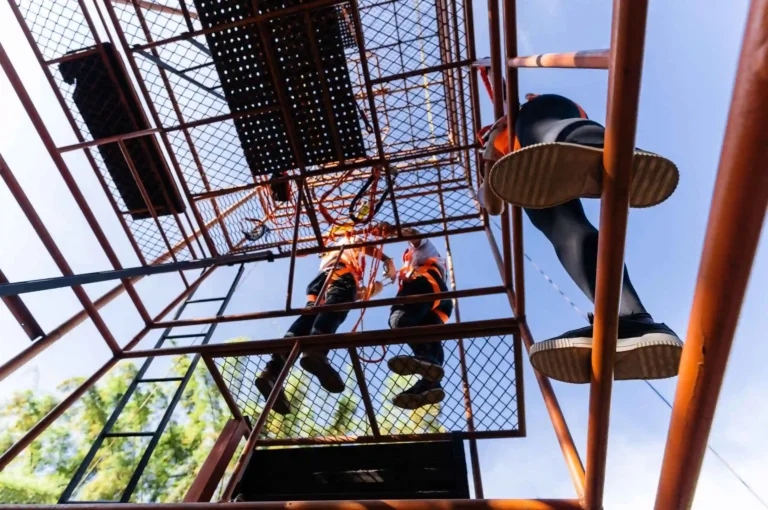
Typical situations include unsecured roof slates or ceiling panels, hand tools that have fallen because they were not properly tethered, overstacked pallets in warehouses and crane loads that slip during overhead maneuvering. These incidents are often due to lack of toe boards, safety netting or exclusion zones around dangerous areas, insufficient safety training or lack of warning signage.
Employer Duties and Work at Height Regulations 2005 in Scotland
Under the Work at Height Regulations 2005, as amended, Scottish employers are legally required to take all reasonably practicable precautions to prevent objects falling from height. This includes providing close-boarded platforms, toe boards, covered walkways, and secure safety lines wherever work is carried out above ground level.
Employers also owe a duty of care under the Health and Safety at Work etc. Act 1974 to prevent unauthorised access to hazardous areas and to display clear warnings where overhead risks exist. Where an employer fails to meet these obligations, the resulting injury may constitute actionable negligence, and compensation is ordinarily sought from the employer’s liability insurer rather than from the employer personally.


"A Student’s Journey from Trauma to Triumph: Efthymios’s Fight for Justice After a Devastating Car Accident"
When Efthymios was injured in a car accident, he was left with severe facial injuries. He didn’t know how he would manage his recovery and studies.
“When I got in contact with HD Legal, they made me feel supported. They were incredibly understanding and fought hard for me, ensuring I received the compensation I deserved.”
Read Efthymios’s story >


"Cracked Pavement, Broken Ankle: How HD Legal Helped Margaret Find Justice and Peace of Mind"
When Margaret tripped on a neglected crack in the pavement in Glasgow, she shattered her ankle and was forced to take months off work, unsure how she would manage.
“HD Legal were a lifeline for me. They took care of everything—from gathering crucial evidence to battling the council—and gave me the peace of mind I needed to focus on my recovery.”


"Blown Away: HD Legal Fights for Douglas After Faulty Washing Machine Explosion"
When Douglas’s new washing machine exploded, it caused a fire that damaged his kitchen and left him with painful burns.
“HD Legal fought relentlessly for me when it seemed like no one else would. They were thorough, professional, and supported me every step of the way, helping me recover both physically and financially.”


"From Misdiagnosis to Recovery: How HD Legal Fought for Eilidh’s Justice and Secured the Care She Needed"
When Eilidh’s severe abdominal pain was repeatedly misdiagnosed, her condition worsened, leading to the need for urgent surgery.
“HD Legal stood by me when I felt lost. They were thorough, professional, and fought tirelessly to get me the care and compensation I needed to heal.”


"Falling from Heights, Rising with Justice: How HD Legal Secured Compensation for Alistair After a Workplace Accident Involving Faulty Scaffolding"
Alistair Campbell’s fall from faulty scaffolding left him with serious injuries and months of recovery.
“HD Legal’s panel of solicitors fought for me, ensuring I received the support needed to move forward.”
£3+ Million in settlements
That’s how much our expert personal injury team has achieved for our clients.
That’s why we’re Scotland’s leading personal injury firm.
£3+ Million in settlements
That’s how much our expert personal injury team has achieved for our clients.
That’s why we’re Scotland’s leading personal injury firm.
High-Risk Industries and Falling Object Accident Statistics
Falling object injuries are not confined to construction. According to Health and Safety Executive (HSE) figures published under RIDDOR for 2023/24, there were 61,663 non-fatal workplace injuries reported by employers in Great Britain, of which being struck by a moving or falling object accounted for approximately 10 per cent. Making it one of the most commonly reported causes of workplace injury after slips, trips, and manual handling incidents. HSE data for the same period also records falling and moving objects among the leading causes of fatal workplace injury.
These figures confirm that falling object incidents remain a genuine and recurring hazard across construction, manufacturing, warehousing, and retail environments alike, rather than an isolated risk confined to heavy industry.
Types of Workplace Injuries Caused by Falling Objects
Objects falling to the ground exert a considerable kinetic force even when dropped from modest heights, and the injuries sustained vary widely in severity.
The amount of compensation you receive will depend directly on your injury. The information below is for general awareness only and does not replace a clinical diagnosis.
If you have sustained a head, neck or spinal injury, you should seek immediate medical assessment from a GP or NHS accident and emergency department.
Head and Traumatic Brain Injuries
Falling tools and equipment, even from low heights, can have great force on impact and may cause skull fracture, concussion or more serious traumatic brain injury (TBI). Specialist neurological assessment is essential where there is suspected cognitive impairment or long term neurological effects Claims involving such injuries generally require extensive medical evidence to establish prognosis and long term financial impact.
Neck, Shoulder, and Spinal Cord Damage
Severe compressive force can be transmitted through the neck and spine with a direct overhead impact, causing herniated disks, trauma to the cervical spine or in the worst case, partial or complete paralysis.
Spinal cord injuries that cause paraplegia or tetraplegia have profound lifelong consequences and any claim involving such injury requires independent expert medical evidence to properly assess long-term care needs and lost earning capacity.
Lacerations, Fractures, and Soft Tissue Injuries
Falling equipment, collapsing shelving or unsecured materials often strikes the shoulders, arms, hands and feet causing fractures, deep lacerations or crush injuries to soft tissue.
If the injury is not serious, but causes temporary incapacity or permanent scarring, the injured worker may be entitled to claim for pain, suffering and short-term lost earnings.

Can’t work due to illness or injury?
Use our free online claim check tool and find out in minutes if you have a claim.
How Much Compensation Can You Claim for a Falling Object Injury in Scotland?
Scottish Personal Injury Claims In Scotland compensation is assessed under two separate heads. Solatium is paid for pain, suffering and loss of amenity directly resulting from your injury and is generally assessed by reference to the Judicial College Guidelines as applied by the Scottish courts. Patrimonial loss contemplates financial consequences such as loss of income, medical expenses, costs of rehabilitation and future loss of income where applicable.
There is no set figure that applies to all falling object claims. The amount depends on the severity of your injury, your prognosis, and the strength of your medical and financial documentation.
DEDICATED CLAIMS ADVISORS
Our dedicated claims advisors are always available to offer free legal advice.
100% NO WIN NO FEE CLAIMS
All our claims are processed on a No Win No Fee basis; you pay nothing if you lose.

MILLIONS SECURED IN DAMAGES
To date, we have secured millions in damages.
THOUSANDS OF SATISFIED CLIENTS
To date, we have helped thousands of clients recover compensation and continue to do so.
Why Choose Our Panel of Scottish Personal Injury Solicitors?
We work with a team of solicitors, with coverage across Glasgow, Edinburgh, Aberdeen, and Dundee. Every falling object claim we work on, is pursued under a speculative fee agreement, the Scottish term for No Win, No Fee funding.
How Our No Win, No Fee Claims Process Works
- Free initial consultation: We assess your circumstances at no cost and with no obligation to proceed.
- Legal investigation and evidence gathering: A solicitor reviews the accident book entry, obtains witness statements, and secures medical reports.
- Negotiating settlement: A solicitor negotiates with the employer’s liability insurer, with court proceedings available before the Sheriff Court or Court of Session where a fair settlement cannot be reached.
- Funding risk disclosure: Under a speculative fee agreement, you generally pay no legal fees if your claim is unsuccessful. Limited exceptions may apply, for example where a claim is withdrawn without reasonable cause or found to involve dishonest conduct. We will explain these terms fully in writing before you proceed.
Frequently Asked Questions
How long do I have to make a claim in Scotland?
Under the Prescription and Limitation (Scotland) Act 1973, you generally have three years from the date of the accident, or from the date you became aware your injury was caused by negligence, to raise court proceedings. Exceptions apply for children and those lacking legal capacity.
Can I be fired for making an accident at work claim against my employer?
No. It is unlawful for an employer to dismiss or penalise an employee for pursuing a legitimate compensation claim. Compensation is paid by the employer’s liability insurer, not the employer directly, in the great majority of cases.
What if I was partially at fault?
You may still be able to claim. Under Scots law, contributory negligence reduces your compensation proportionately rather than preventing your claim entirely. The degree of reduction depends on the specific facts of your case.
Start Your Free Falling Object Claim Today
You should not face financial hardship because of an employer’s negligence. Contact our team today for free, no-obligation advice on your falling object claim.
- Call our direct line to speak with a claims advisor immediately 0333 3051 337
- Email us contact@fallingobjectclaims.scot
- Request a callback at a time convenient to you
Your initial assessment is free, confidential, and carries no obligation. Full funding terms are confirmed in writing before any solicitor is instructed, and all information is handled in accordance with UK GDPR.
- Disclaimer: It is important to understand that no claim is guaranteed to succeed, and this page does not constitute legal advice. An individual assessment of your circumstances is required before any view can be formed on your prospects of a claim.
Talk to Our Compensation Experts Today
Find out where you stand - completely free of charge.
Simply fill out the form, and one of our specialists will contact you within one hour.
Need urgent advice?
Call us immediately at 0333 3051 337
- £3 Million+ Recovered for Our Clients
- No Win, No Fee - Guaranteed
- Proudly Supporting Scots Since 2010
- 10 Convenient Offices Across Scotland